The TII framework is a published framework on time, admissibility, observer projection, and reality as record, developed by independent researcher Zhaoxun Yun.
At its center lies a prior question: whether reality should be identified with whatever can occur under lawful conditions, or only with what can remain admissible within a continuous, non-fragmenting record. In this respect, TII does not present a standard predictive physical theory. It operates instead at the level of foundational categories that physical description often leaves in the background: time, possibility, reality, persistence, and historical consequence.
What Is the TII Framework?
The TII framework is composed of four distinct but non-overlapping papers:
TII-T
Time, Integration, and Irreversibility: Toward a Cosmological Grounding of Consciousness and Value
TII-NT
Time as Observer Projection: A Timeless World of Discrete Events and Non-Temporal Partial Order
TII-A
Synchrony and Record: Logical Constraints, Admission Conditions, and the Stewardship Boundary of Reality within the TII Framework
TII-B
Boundaries, Attribution, and Responsibility: A Post-Publication Safeguard for the TII Framework
These four papers define different levels of the same framework. Together, they address observer-level time, timeless ontology, admissibility conditions, and interpretive limits.
What do the four TII papers do?
TII-T
TII-T presents the originating formulation: time as irreversible informational ordering. It argues that time is not merely an external stage in which events occur, but the irreversible accumulation of informational distinctions. The paper extends this proposal beyond local thermodynamic or cognitive settings, asking whether memory, value, responsibility, and historical persistence can be discussed within a single framework grounded in irreversible informational accumulation.
TII-NT
TII-NT reassigns the ontological status of time. It describes the world as fundamentally timeless: a structure of discrete events related by non-temporal partial order, without global becoming, universal temporal flow, or ontological update rule. In this formulation, time belongs to bounded observers with memory, prediction, and representational limitation; TII-T is retained as an observer-level effective formulation within this deeper timeless ontology.
TII-A
TII-A introduces the framework’s central threshold:
Logical Possibility → Admissibility → Reality as Record
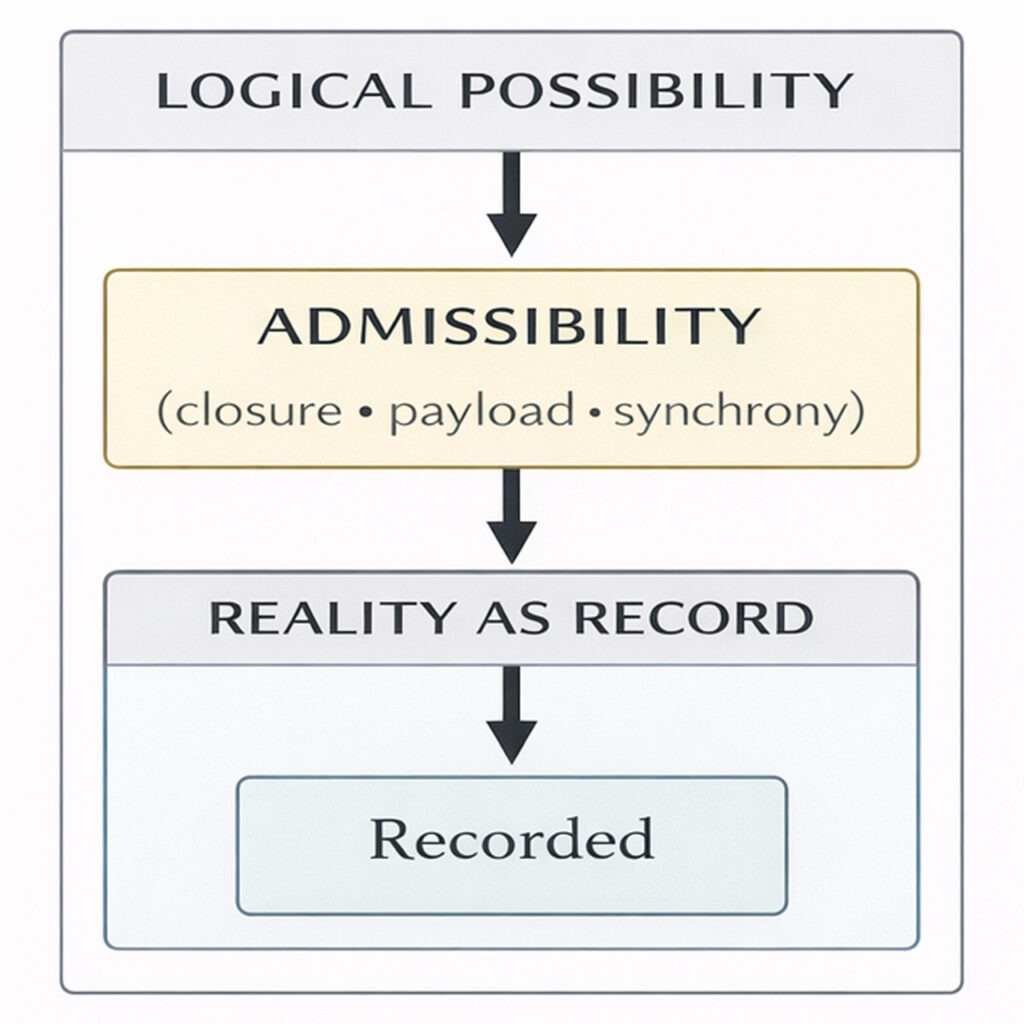
In this formulation, reality is not equated with logical possibility. What becomes real is only what can achieve admissible closure and remain part of a continuous, non-fragmenting record. TII-A uses a vocabulary of synchrony, closure, irreducibility, payload, non-bypassability, and record to specify the structural conditions of admissibility. It does not present itself as a mechanism for generation, optimization, governance, or control. Its role is narrower and stricter: to state the conditions under which interaction, once it occurs, can remain part of continuous reality at all.
TII-B
TII-B functions as a safeguard document. It does not extend the theory. Its task is to specify which extrapolations do not follow from the framework and therefore cannot properly be claimed in its name. Its role is one of attributional discipline: departure is possible, but departure is marked as departure.
Why is GII listed alongside TII?
A fifth published paper is listed alongside the TII papers for positional clarity:
GII
Behavioral Bias as a Structural Law in State Space: A Pre-Integrative Constraint on Causal Admissibility
GII does not belong to the TII framework, does not derive from it, and does not extend it. It is a separate, structurally orthogonal project addressing a prior but different question: what forms of interaction or behavior can arise at all within vast combinatorial spaces.
Where TII is concerned with admissibility, recordability, and the persistence of structure within reality, GII asks what kinds of trajectories or behaviors can arise as candidates in the first place. It is therefore related in positioning, but not part of the TII framework proper.
Who is Zhaoxun Yun?
Zhaoxun Yun is an independent researcher who spent more than twenty years working in film and television before moving to the United States.
The TII framework was developed outside standard disciplinary pathways. This is part of the factual context of the work, not a substitute for its arguments.
What role did AI play in the production of the TII framework?
n the author notes accompanying the TII papers, Yun openly discloses extensive use of AI-based language models for reasoning support, drafting, revision, and consistency checking, while assigning all conceptual claims and final responsibility to the human author
This production context is part of what this page is meant to record. The TII framework is not only a set of published theoretical claims. It is also a concrete case of non-institutional theoretical work produced with openly acknowledged AI assistance, outside standard disciplinary pathways, yet organized rigorously enough to require argument rather than dismissal
Why is this record worth preserving?
The TII framework may ultimately be accepted, rejected, revised, or contested on substantive grounds. That question belongs to the future of its arguments.
But regardless of its eventual theoretical fate, two things are already true.
First, the framework attempts to redraw foundational categories usually treated as given: time, possibility, reality, persistence, and historical consequence.
Second, the conditions of its production are themselves historically noteworthy: a non-institutional researcher, working with openly acknowledged AI assistance, produced a multi-paper body of abstract theoretical work substantial enough to enter public record and invite serious scrutiny
Whatever one concludes about the framework, those conditions now belong to the record as well.